
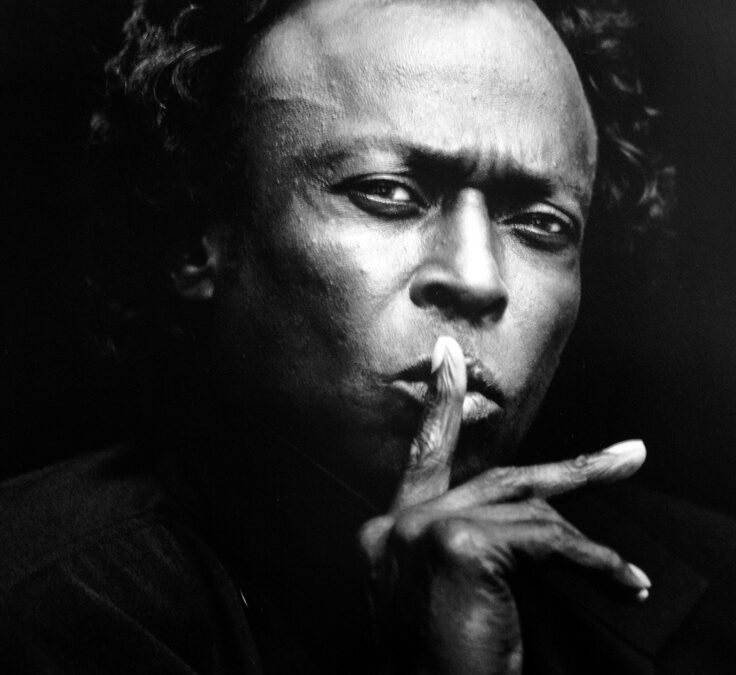
Miles Davis did not simply play the trumpet — he changed the direction of music.
For me, Miles represents courage: the courage to search, to break form, to challenge tradition, and to keep evolving. He understood that jazz is not a museum piece. It is alive, restless, curious, and always moving forward.
As an African artist, I hear in Miles a deep lesson: respect the roots, but do not be afraid to create a new language from them. His music reminds us that silence can speak, that space has rhythm, and that true innovation comes from listening deeply.
What inspires me most is that (as noted by Leonard Pitt jr, a Miami Herald Pop Critic, writing his obituary in September 1991), even at the end, Miles was still chasing his muse into places where others wished he would not go. His interpretation of Cyndi Lauper’s Time After Time raised eyebrows, and in Miles: The Autobiography, published just two years before his passing, he was already speaking about Prince and even exploring the possibilities of rap music.
That fearless curiosity is the true spirit of jazz.
One of his reflections from his Autobiography stays with me deeply:
“For me, the urgency to play and create music is worse than when I started. It’s more intense… I’m driven to it — go to bed thinking about it and wake up thinking about it. It’s always there. And I love that it hasn’t abandoned me; I feel really blessed.”
Today on Africa Day (May 25th) and celebrating Miles Davis on what would have been his 100th birthday (May 26th), I honour him not only as one of the greatest musicians of all time, but as a fearless artist who gave generations permission to be free.
The late Manu Dibango and I paying homage with this re-arrangement of a classic.
https://open.spotify.com/
Moreira Chonguiça